

Ry Cooder
Today we celebrate the birthday of
Ry Cooder, one of the most versatile musicians America has produced.
Further on in this blog: his biography.
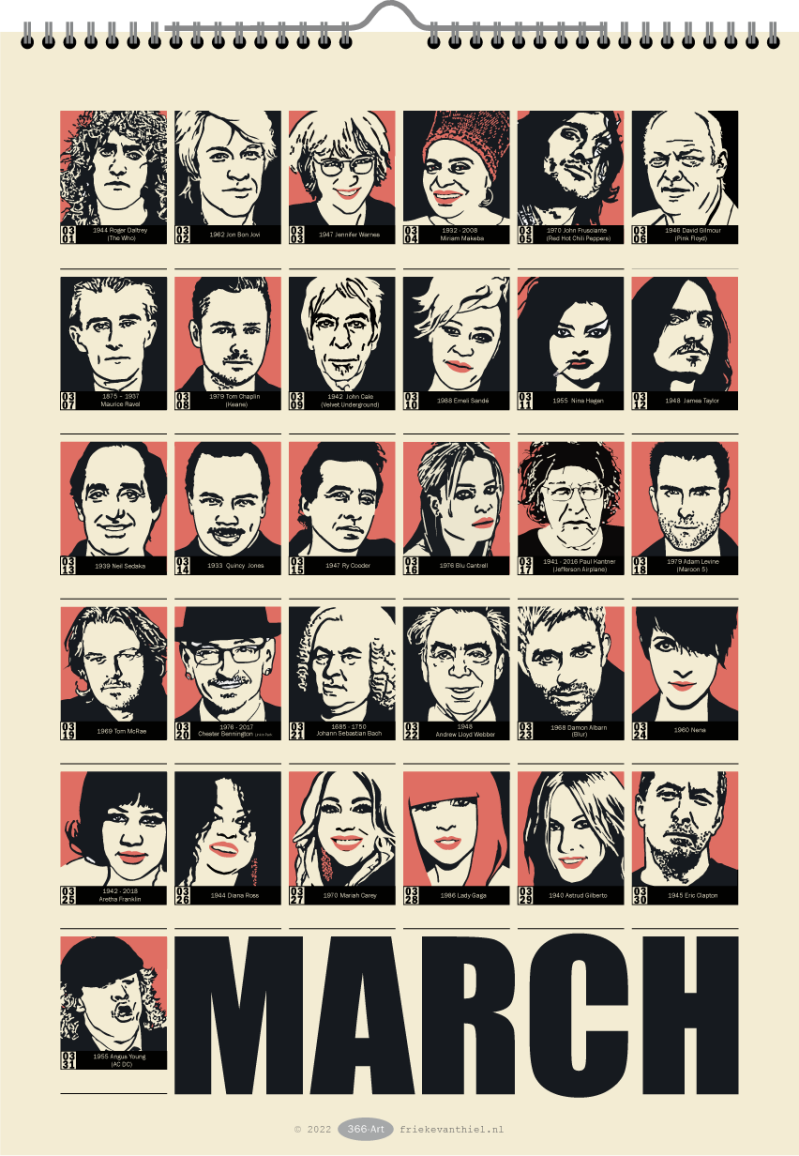
The digital edit above and the
366 musical birthdays, calendar
are made by me, Frieke.
Click on the image to view the calendar.
Ry Cooder: The Master of Slide Guitar and Roots Music
Ry Cooder is one of the most influential and versatile musicians America has ever produced. As a guitarist, composer, singer, and producer, he has spent decades pushing the boundaries of musical genres, leaving an indelible mark on the world of roots music, blues, world music, and film scores. His name is inseparably linked to the rediscovery of Cuban music through the legendary Buena Vista Social Club project.
Early Years and Musical Formation
Ryland Peter Cooder was born on March 15, 1947, in Los Angeles, California. From his earliest years, he displayed an extraordinary affinity for music. As a child, he became fascinated by the sounds of blues, folk, and country he heard on the radio. At the age of ten, he began playing the guitar and quickly developed a unique, recognizable playing style.
In his teenage years, he studied with the legendary blues guitarist Reverend Gary Davis, from whom he learned the bottleneck and slide techniques that would become his trademark. These early influences — from Appalachian folk to Delta blues — formed the basis of his later musical identity. Los Angeles was a vibrant musical hub at the time, and the young Cooder absorbed everything he heard around him.
Breakthrough and Collaboration with the Greats
In the 1960s, Cooder began his professional career as a session musician in Los Angeles. His reputation as a guitar virtuoso grew rapidly, and he was invited to contribute to recordings by major artists. He played on The Rolling Stones' album 'Let It Bleed' (1969), where his bottleneck guitar work on Sister Morphine made a deep impression.
In 1970, Cooder released his self-titled debut album, which immediately attracted the attention of music critics and enthusiasts worldwide. This album laid the foundations of his musical philosophy: rescuing and reinterpreting forgotten American musical heritage. From Blind Willie Johnson to Lead Belly — Cooder breathed new life into old blues and folk songs without losing their soul.
The Film Score Masterpiece: Paris, Texas
One of the high points of Ry Cooder's career is undoubtedly his soundtrack for the film Paris, Texas (1984), directed by Wim Wenders. The sparse, melancholic slide guitar passages he composed for this film are considered one of the most emotionally powerful film soundtracks of all time. The music of Paris, Texas perfectly captures the loneliness and desolation of the American landscape.
This collaboration with Wenders also led to the documentary 'Buena Vista Social Club' (1999), which would play a crucial role in the next great chapter of Cooder's career. His film compositions for works such as 'The Border', 'Southern Comfort', and 'Crossroads' confirmed his position as one of the most sought-after film composers of his generation.
Buena Vista Social Club: A Musical Revolution
In 1996, Ry Cooder traveled to Cuba with the mission of recording a forgotten generation of Cuban musicians. What he found there was nothing short of a musical miracle. Together with producer Nick Gold, he brought together veterans such as Ibrahim Ferrer, Compay Segundo, Rubén González, and Omara Portuondo in the recording studio.
The resulting album Buena Vista Social Club (1997) became a worldwide sensation. It won a Grammy Award and sold millions of copies globally. The music — a blend of son, bolero, and other traditional Cuban styles — reached an audience that would normally never listen to Cuban music from the 1940s and 1950s. The Wim Wenders documentary that followed made the story even bigger and changed the lives of the Cuban musicians involved forever.
The Buena Vista Social Club project is often described as one of the most significant contributions to world music in the twentieth century. It relaunched the term 'world music' as a serious artistic category and inspired a new generation of musicians to collaborate across borders.
Political and Social Engagement
Ry Cooder has never minced words when it comes to political and social issues. In his later work, particularly the albums Chavez Ravine (2005) and My Name Is Buddy (2007), he uses music as a means of telling forgotten stories of marginalized communities. 'Chavez Ravine' documents the forced displacement of a Mexican-American community in Los Angeles in the 1950s to make way for a baseball stadium.
In the twenty-first century, Cooder has increasingly become a political commentator through his music. Albums such as 'Pull Up Some Dust and Sit Down' (2011) and 'The Prodigal Son' (2018) contain sharp criticism of social inequality, institutional racism, and the state of American democracy. His music has thus become not only an artistic statement but also a social document.
Musical Style and Legacy
What sets Ry Cooder apart from other guitarists is his profound knowledge of and respect for musical traditions that are in danger of disappearing. His slide guitar playing, in which he moves a glass or metal tube over the strings, is immediately recognizable: expressive, vocal, and always in service of the music. He has never sought virtuosity for its own sake, but always emotional honesty.
Cooder has collaborated with musicians from around the world, from Indian guitarist Vishwa Mohan Bhatt (the Grammy-winning album A Meeting by the River, 1993) to Malian musician Ali Farka Touré and Japanese musician Shoukichi Kina. Each of these collaborations demonstrates his ability to transcend cultural boundaries without losing his own artistic identity.
Discography Highlights
Ry Cooder's discography spans more than fifty years and includes numerous masterworks. Some highlights include: the debut album 'Ry Cooder' (1970), the blues collection 'Paradise and Lunch' (1974), the influential 'Chicken Skin Music' (1976) with Tex-Mex and Hawaiian influences, the soundtrack 'Paris, Texas' (1984), the collaboration 'A Meeting by the River' with Vishwa Mohan Bhatt (1993), the cultural-historical 'Buena Vista Social Club' (1997), and the political albums 'Chavez Ravine' (2005) and 'The Prodigal Son' (2018).
Essential Songs
Beyond his albums, Ry Cooder has a remarkable collection of individual tracks that perfectly illustrate his breadth as a musician. Below is a selection of the most essential songs from his career.
Vigilante Man (1971) — A chilling interpretation of Woody Guthrie's protest song, in which Cooder's slide guitar powerfully reinforces the mood of menace and social injustice. This track demonstrates his gift for making historical texts feel timeless.
Dark End of the Street (1974, on 'Paradise and Lunch') — Originally by Dan Penn and Chips Moman, but Cooder's version is simply heartbreaking. His restrained, bluesy approach to this song of infidelity ranks among the finest things he has ever recorded.
Fool for a Cigarette (1974) — A moving blues rendition of Ellas McDaniel's classic, steeped in southern melancholy and featuring some of Cooder's most expressive slide guitar playing.
He'll Have to Go (1976, on 'Chicken Skin Music') — His Tex-Mex reworking of this country classic illustrates his ability to blur the boundaries between styles. With accordion and bajo sexto, it sounds as if the song was always meant to be played this way.
Get Rhythm (1987) — His hypnotic cover of Johnny Cash's early Sun Records classic brings an infectious energy that shows how Cooder can refresh rockabilly and roots music without losing its essence.
'Paris, Texas (Main Theme)' (1984) — This instrumental masterpiece, with its sparse, lonely slide guitar, may well be the most celebrated piece Cooder has ever composed. The soundscape of the Texan desert, its emptiness and longing, is captured in just a handful of notes. Essential listening.
Feelin' Bad Blues (1993, on 'Talking Timbuktu' with Ali Farka Touré) — This track embodies the heart of the album: the deep kinship between West African music and American delta blues. Cooder and Touré communicate through their guitars in a way that makes language barriers entirely irrelevant.
Chan Chan (1997, on 'Buena Vista Social Club') — Although this song was written by Compay Segundo, Cooder's production played an essential role in the recording. The opening track of the album became a worldwide symbol of the Cuban musical renaissance.
Across the Borderline (1987) — Written by Ry Cooder together with John Hiatt and Jim Dickinson, this is one of his best-known and most covered compositions. The story of migrants trying to cross the border to a better life is timeless and more poignant than ever. Willie Nelson and Freddy Fender later recorded their own versions.
Jesus on the Mainline (1979, on 'Bop Till You Drop') — An explosive gospel-rock interpretation that demonstrates how effortlessly Cooder can combine the energy of the church and the roadhouse. The version on this album is pure joy.
Little Sister (1979, on 'Bop Till You Drop') — Originally written by Doc Pomus and Mort Shuman for Elvis Presley in 1961, but Cooder's version has a character entirely its own. Tight, rhythmic, and driven by his distinctive guitar sound, it became his most commercially successful single — a number-one hit in New Zealand.
Conclusion: A Living Musical Legacy
Ry Cooder represents the very best that American roots music has to offer: curiosity, respect for tradition, technical mastery, and a deep humanist conviction. In a music industry dominated by trends and commercial pressure, he has always charted his own course, building a body of work that will far outlast its time.
Whether it is his masterful slide guitar on a blues standard, his heartbreaking film music, or his role as a cultural ambassador for forgotten musical traditions from around the world — Ry Cooder remains an indispensable voice in world music. His life and work are proof that music truly has the power to connect people and cultures across every divide.

Reactie plaatsen
Reacties