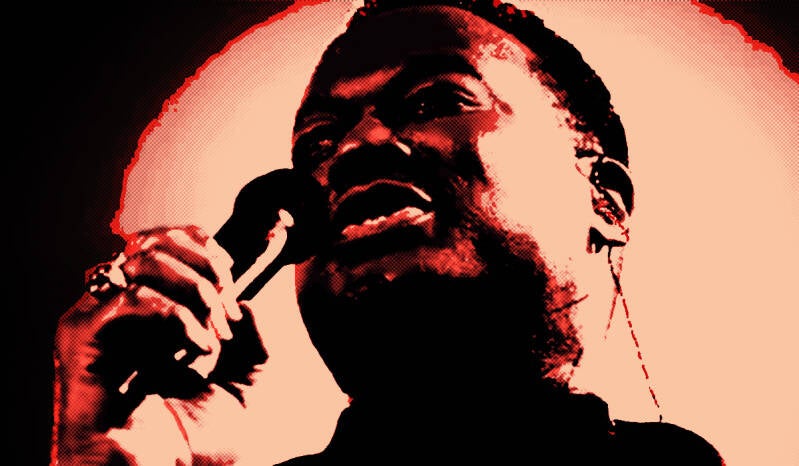

LUTHER VANDROSS
(1951–2005)
The Voice That Touched the Soul
April 20 | The birthday of Luther Vandross, one of the most renowned R&B singers
of the late 20th century.
Further down this blog, you can read his biography.
The digital edit of his portrait and
the '366 Musical Birthdays Calendar'
were created by me, Frieke.
Click on April to view the calendar.

Luther Vandross: The Life and Music of a Soul Legend
Luther Vandross was one of the most influential soul and R&B singers in music history. With a voice of extraordinary warmth and technical brilliance, he touched the hearts of millions around the world. From his modest beginnings in New York City to his status as a global music icon, the story of Luther Vandross is one of remarkable talent, perseverance, and an unwavering devotion to the craft of music.
Early Life and Childhood in New York (1951–1970)
Luther Ronzoni Vandross Jr. was born on April 20, 1951, in New York City. He grew up in the Alfred E. Smith Houses, a housing project on the Lower East Side of Manhattan. Music was a constant presence in his life from the very beginning: his mother sang gospel in church, and his sister Mary performed with a doo-wop group. As a child, he idolized Dionne Warwick and would spend hours listening to her records, studying every nuance of her phrasing.
As a teenager, Vandross demonstrated exceptional musical aptitude. He taught himself to play the piano and began writing songs while still in high school. His deep love for soul, pop, and gospel—particularly the music of Aretha Franklin and Stevie Wonder—laid the foundation for his own distinctive sound.
Building a Career: Background Singer and Composer (1970–1981)
After briefly attending Western Michigan University, Vandross returned to New York to pursue his musical ambitions. Throughout the 1970s, he built an impressive reputation as a background vocalist and studio arranger. He collaborated with a wide range of celebrated artists, including David Bowie, Bette Midler, Donna Summer, Diana Ross, and Chic.
His gift for writing and arranging music was extraordinary. He composed jingles for major brands and contributed to productions that would later serve as a springboard for his solo career. In 1976, he formed a group called Luther, releasing two albums, but significant commercial success remained elusive at that stage.
Solo Career and International Breakthrough (1981–1990)
The real breakthrough came in 1981 with the release of his debut solo album Never Too Much on Epic Records. The title track became an instant hit, introducing the world to the full power of his voice: smooth, rich, and brimming with emotion. The album established him as a major solo recording artist and launched one of the most celebrated careers in R&B history.
Throughout the 1980s, Vandross released a succession of highly successful albums, including Forever, for Always, for Love (1982), Busy Body (1983), and Give Me the Reason (1986). His music was defined by romantic ballads and uptempo R&B grooves, always anchored by his extraordinary vocal range. A gifted producer as well as a performer, he took a hands-on approach to crafting his sound, often producing and arranging his own records.
Grammy Success and Career Pinnacle (1990–2002)
The 1990s marked the pinnacle of Luther Vandross’s commercial and critical success. He won multiple Grammy Awards, including Best Male R&B Vocal Performance, and collaborated with some of the biggest names in music. His duet with Mariah Carey on Endless Love (1994) became a major hit, while his recording with Beyoncé on The Closer I Get to You further broadened his already considerable audience.
Albums such as Power of Love/Love Power (1991) and Songs (1994) achieved major commercial success. His recording of Here and Now became one of the most played wedding songs in the world, a testament to his unique ability to capture the essence of love and romance in music. Vandross possessed a rare gift for making listeners feel understood and seen, which earned him a devoted and diverse fan base across generations.
Health Struggles and Final Chapter
In April 2003, Luther Vandross suffered a severe stroke that profoundly affected his health and his ability to perform. Despite his difficult recovery, he was able to celebrate a remarkable triumph that same year: his album Dance with My Father (2003) and its title track won four Grammy Awards, including Song of the Year and Best R&B Album. The project was a deeply personal tribute to his father, who had passed away when Luther was just eight years old, and it resonated with listeners around the world.
On July 1, 2005, Luther Vandross passed away at the age of 54 following a heart attack, a complication of his earlier stroke. His death was mourned by fans and fellow artists across the globe. He left behind a musical legacy of more than thirty million albums sold, eight Grammy Awards, and an enduring catalog of songs that continue to be played at weddings, featured in films and television, and celebrated on radio stations worldwide.
Musical Legacy and Enduring Influence
The influence of Luther Vandross on contemporary soul and R&B music is profound and far-reaching. Artists including John Legend, Sam Smith, Ne-Yo, Maxwell, and many others have cited him as one of their greatest inspirations. His vocal style—characterized by masterful use of melisma, extraordinary breath control, and deeply emotive phrasing—has shaped the work of countless singers across generations.
Luther Vandross remains one of the greatest voices in the history of recorded music. Whether it is the tender romance of Here and Now, the irresistible groove of Never Too Much, or the heartbreaking beauty of Dance with My Father, his music speaks timelessly to the hearts of all who have ever loved or longed for love. His legacy endures not merely in the records he left behind, but in every note of inspiration he passed on to the artists who came after him.
"A man is not judged by what he does for himself, but what he does for others."
Luther Vandross
Reactie plaatsen
Reacties