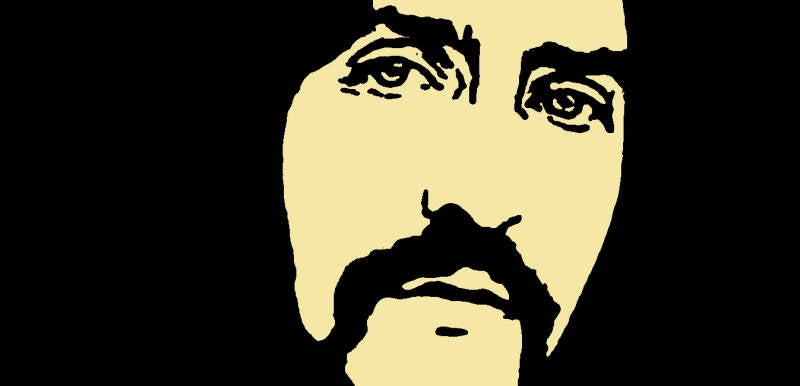

Barış Manço
(1943–1999)
Today we celebrate the birthday of
Barış Manço, one of the most iconic and beloved musicians in Turkish history.
Further on in this blog: his biography.
The digital edit of his portrait and the 366 European Musicians birthday calendar are made by me, Frieke.
Click on January to view the calendar.

Barış Manço: The Legend of Anatolian Rock
Barış Manço (January 2, 1943 – February 1, 1999) was one of the most iconic and beloved musicians in Turkish history. As a singer, songwriter, television presenter, and cultural ambassador, he left an indelible mark on Turkish popular culture. His music fused traditional Anatolian folk music with Western rock and psychedelia — a sound that continues to be treasured by fans around the world to this day.
Early Life and Youth (1943–1962)
Barış Manço was born in Üsküdar, Istanbul. He grew up in a culturally conscious family and showed a deep passion for music from an early age. By the time he was ten, he had begun playing the guitar, heavily influenced by Elvis Presley and the emerging Western rock scene.
After completing secondary school, he moved to Belgium, where he studied at the Royal Academy of Fine Arts in Brussels. In Europe, he encountered beat music and the psychedelic rock of the 1960s — experiences that would profoundly shape his later musical style.
Musical Career and Breakthrough
Early bands: In the late 1950s, Manço formed his first band: Harmoniler. This was followed by Kaygısızlar and eventually Kurtalan Ekspres — his loyal backing band with whom he would collaborate for decades.
His breakthrough as a solo artist came in the early 1970s with songs that seamlessly wove folk music together with electric guitars and Western rhythms. This genre later became known as 'Anadolu Rock' (Anatolian Rock) — a movement of which Manço was one of the founding figures, alongside artists such as Cem Karaca and Moğollar.
Iconic Albums and Songs
Barış Manço's discography spans around twelve studio albums and dozens of singles that have influenced generations of Turkish listeners. Some of his most celebrated works include:
- Dağlar Dağlar — a folk classic with a rock edge, one of his earliest hits.
- Hal Hal — an ode to Anatolian culture, with captivating instrumentation.
- Gülpembe (1981) — perhaps his most beloved song, a tender tribute to his mother. A timeless classic.
- 2023 — a concept album about the future of Turkey, released in 1975.
- Sarı Çizmeli Mehmet Ağa — a lively folk rock number that became an anthem.
7'den 77'ye — The Television Programme
Beyond his musical career, Barış Manço became widely celebrated as the host of the television programme 7'den 77'ye ('From 7 to 77'), which aired on TRT from 1988 to 1999. It was an educational and cultural programme in which he travelled, conducted interviews, and addressed viewers of all ages. He brought the cultures, traditions, and folk music of dozens of countries to Turkish audiences.
The programme reached millions of viewers in Turkey and the Turkish diaspora and shaped an entire generation. Manço presented the world in an accessible and warm manner, fostering respect and curiosity for other cultures.
Appearance and Cultural Iconography
Barış Manço was unmistakably recognisable for his extravagant bracelets, his long black hair, and his colourful costumes — a blend of traditional Turkish elements and Western rock aesthetics. His image was as unique as his music, making him a visual icon of Turkish popular culture.
International Recognition
Barış Manço enjoyed international recognition, particularly in Japan, where he built a loyal fan base. He was one of the few Turkish artists to successfully break into the Japanese market, partly through his performances and tours in the country.
In Belgium, the country where he had studied, he was regarded as a bridge between East and West — someone who brought Turkish culture to Europe in an authentic and personal way.
Death and Legacy
On 1 February 1999, Barış Manço died suddenly of a heart attack in Istanbul at the age of 56. His death shocked the entire nation. Thousands gathered to mourn him, and his funeral was broadcast live on television.
His music lives on. New generations discover his work through streaming platforms and social media, and his songs are regularly covered by contemporary artists. In Turkey, streets, parks, and cultural institutions have been named after him. His home in Istanbul has been converted into a museum — the Barış Manço Evi — which attracts thousands of visitors every year.
Barış Manço and the Music World Today
The influence of Barış Manço on Turkish music cannot be overstated. He proved that folk music and rock can coexist without sacrificing authenticity. He inspired countless artists in Turkey and beyond, and his work is considered a fundamental pillar of Anatolian musical identity.
His songs are still played at weddings, festivals, and cafés throughout Turkey. His lyrics, filled with poetry and philosophy, resonate across generations. Barış Manço was not merely a musician — he was a cultural movement in himself.
© All rights reserved. This article is intended for informational and educational purposes.

Reactie plaatsen
Reacties