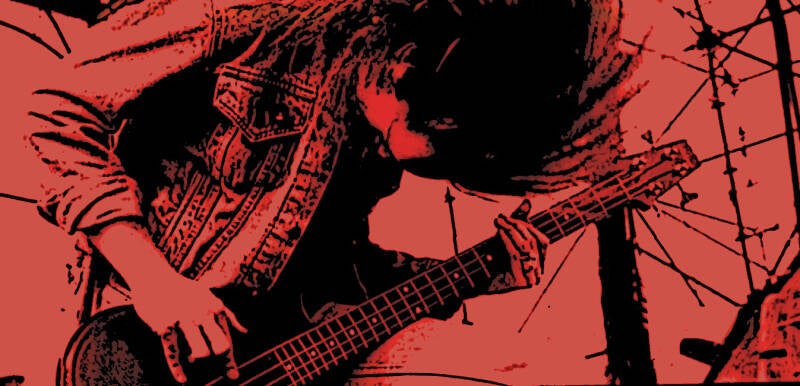

CLIFF BURTON
The Life and Work of a Bass Legend
Today we celebrate the birthday of Cliff Burton, one of the greatest bassists
in the history of rock music.
Further on in this blog: his biography.
The digital edit above and the birthday calendar featuring 366 famous musicians are made by me, Frieke.
Click on the image to view the calendar

Introduction
Cliff Burton (February 10, 1962 – September 27, 1986) is widely regarded as one of the greatest bassists in the history of rock music. As a member of thrash metal giants Metallica, he helped shape a genre that would captivate millions worldwide. His unique playing style, profound musical knowledge, and charismatic personality made him an iconic figure whose impact on music history remains undiminished decades after his tragic death.
Childhood and First Steps in Music
Clifford Lee Burton was born on February 10, 1962, in Castro Valley, California. From an early age, he displayed a remarkable affinity for music. He began playing piano at the age of eight, but after the sudden death of his brother Scott in 1975, Cliff devoted himself entirely to the bass guitar as a tribute to his brother. His parents — Ray and Jan Burton — fully supported his musical passion and encouraged him to pursue it at every turn.
It quickly became evident that Cliff possessed extraordinary talent. While most teenagers struggled with basic technique, Burton was already studying classical music and developing skills far beyond what a bassist was expected to know. He absorbed influences from Jimi Hendrix, Black Sabbath, and classical composers such as Bach and Mozart, forging a musical identity that was entirely his own.
Education and Musical Influences
Burton attended Chabot College in Hayward, California, where he deepened his understanding of music theory. His grasp of harmony, counterpoint, and composition was exceptional for a heavy metal musician — or any rock musician of his era. This academic foundation allowed him to approach the bass as a compositional instrument rather than merely a rhythmic one, a philosophy that would later transform the sound of Metallica.
Cliff Burton and Metallica: A Revolutionary Era
Joining Metallica (1982)
In 1982, Cliff Burton joined Metallica after the band relocated from Los Angeles to San Francisco — a condition Burton himself had demanded before agreeing to join. He replaced bassist Ron McGovney and immediately brought a new musical direction to the group. Alongside James Hetfield, Lars Ulrich, and Dave Mustaine (later replaced by Kirk Hammett), Metallica entered a period of explosive creativity that would redefine an entire genre.
Burton's impact on Metallica was immediate and profound. Where a bassist traditionally plays a supportive role, Burton became a fully equal musical force within the band. He introduced melodic bass lines, harmonies, and a playing approach that pulled the instrument out from behind the shadow of the guitarists, placing it at the forefront of the band's sound.
Kill 'Em All (1983)
With their debut album Kill 'Em All (1983), Metallica made clear that thrash metal was a serious musical force. Burton's bass was prominently featured throughout, most notably on the instrumental track Anesthesia — (Pulling Teeth), in which he performs an extended bass solo that remains celebrated to this day as a landmark in bass guitar history. His use of a wah pedal — an effect typically reserved for guitarists — was revolutionary for the genre and became one of his defining sonic signatures.
Ride the Lightning (1984)
The second album, Ride the Lightning (1984), demonstrated the continued evolution of Metallica as composers, with Burton's influence clearly audible throughout. His contributions to tracks such as For Whom the Bell Tolls — with its iconic, earth-shaking intro — and the classic ballad Fade to Black illustrate his ability to combine emotional depth with technical precision. Fade to Black is widely considered one of the most influential ballads in metal history and marked a significant turning point in the band's willingness to explore slower, more melodic territory.
Master of Puppets (1986): The Magnum Opus
Master of Puppets (1986) is regarded by critics and fans alike as the pinnacle of Burton's musical contribution to Metallica — and as one of the greatest metal albums ever recorded. The album showcases his ability to write complex, multi-voiced bass parts that strengthen the whole without overshadowing the other instruments. The title track is a masterwork of structure and dynamics, with Burton's bass lines playing an indispensable structural role throughout its nearly nine-minute runtime.
On this album, Burton also composed Orio, an instrumental piece that fully reveals his classical influences. The composition carries a symphonic quality and proves that Burton thought far beyond the boundaries of the metal genre. Orion continues to be played at funerals, weddings, and in film scores — a testament to its timeless emotional power and compositional sophistication.
The Tragic Death of Cliff Burton
The Bus Accident on September 27, 1986
On September 27, 1986, during a European tour in support of Master of Puppets, Metallica's tour bus crashed near Kronoberg, Sweden. The bus skidded off the road on an icy surface, and Cliff Burton was thrown from a window. He died at the scene at just 24 years of age. The precise cause of the accident remained the subject of debate for years; reports pointed to black ice, a possible broken rear axle, and alleged driver error as contributing factors.
The death of Cliff Burton sent shockwaves through the music world. James Hetfield, Lars Ulrich, and Kirk Hammett lost not only a bandmate but a brother, a musical mentor, and a creative soul of rare depth. Lars Ulrich described Burton as the most talented person he had ever met — a sentiment echoed by countless musicians, journalists, and fans in the years that followed.
The Aftermath
The death of Cliff Burton marked a turning point in Metallica's career. The band recruited Jason Newsted as his replacement and continued, but many observers believe Metallica never again reached the same level of musical depth and complexity it had achieved during the Burton era. His legacy, however, endures: generations of bassists around the world consider him their greatest source of inspiration.
Musical Style and Technique
Unique Playing Techniques
Cliff Burton was renowned for his use of the wah-wah pedal on the bass guitar — a technique that at the time was used almost exclusively by guitarists. This gave his playing an expressive, singing quality that transformed the bass into a lead instrument. His fingerpicking technique, combined with an aggressive attack, gave his playing a raw energy without sacrificing melody or nuance.
His use of distortion effects on the bass was equally groundbreaking. By employing effect pedals designed for electric guitar, Burton developed a sound that was unique and immediately recognizable. This approach inspired countless bassists who followed in his footsteps, including Flea of the Red Hot Chili Peppers and Robert Trujillo, Metallica's current bassist.
Music Theory and Compositional Contributions
Burton was more than a technician — he was a composer. His knowledge of music theory enabled him to write complex harmonies and melodies that gave Metallica's songs an unprecedented depth. Working in close collaboration with his bandmates, he helped construct musical architectures that pushed the boundaries of the metal genre. His influence is audible in the progressive elements that distinguished Metallica from contemporaries such as Slayer and Anthrax.
Cliff Burton's Legacy in the Music World
Influence on Future Generations
The influence of Cliff Burton on the music world is difficult to overstate. Bassists in genres ranging from metal to jazz to funk cite him as a primary source of inspiration. His approach to the bass as a melodic and harmonic instrument — rather than merely rhythmic support — changed the way the world views bassists in rock bands, elevating their role to that of a fully expressive musical voice.
Bands such as Tool, Rage Against the Machine, and System of a Down have acknowledged his influence on their music. In polls and lists of the Greatest Bassists of All Time, Burton consistently appears in the top five, alongside legends such as Jaco Pastorius and John Entwistle.
Commemoration and Memorials
In the years following his death, Cliff Burton has been commemorated in numerous ways. In Castro Valley, his hometown, a park was named in his honor: the Cliff Burton Memorial Park. Metallica dedicates a portion of every setlist to his memory, and Orion is regularly performed as a tribute. In 2009, Burton was posthumously inducted into the Rock and Roll Hall of Fame alongside the other members of Metallica.
His father, Ray Burton, established the Cliff Burton Scholarship, which provides annual financial support to music students — a tangible expression of the enduring impact his son left behind.
Conclusion
Cliff Burton lived only 24 years, but his contribution to music transcends the limits of his short life. As a bassist, composer, and musical visionary, he altered the trajectory of Metallica and of heavy metal as a whole. His technical brilliance, combined with a deep sense of melody and composition, makes him a figure who has permanently marked music history. Cliff Burton is not merely a bassist — he is a legend.

Reactie plaatsen
Reacties